

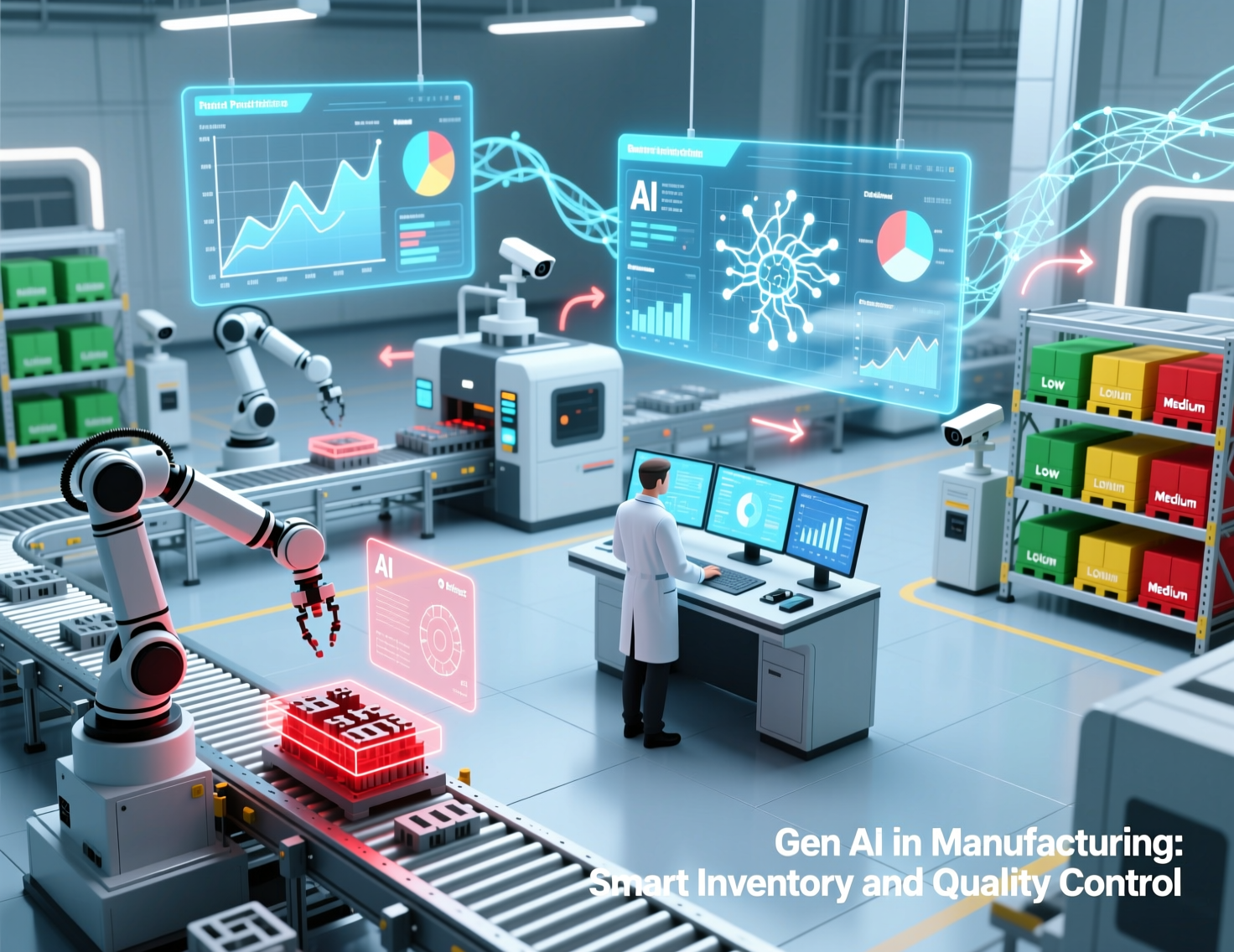
Gen AI in Manufacturing: Smart Inventory Management and Quality Control
Introduction
In the era of smart manufacturing, simply automating tasks is no longer enough. Business leaders and CTOs are asking: how can we bring real intelligence into production, not just machines that do, but systems that think, adapt and improve? That’s where generative artificial intelligence (Gen AI) comes into play and why this topic matters now more than ever. With global supply-chain pressure, rising material costs, and quality expectations soaring, manufacturing enterprises must re-imagine how they manage inventory and ensure quality control. The right Gen AI solution can make a difference between being reactive and being predictive.
In this article we’ll explore how Gen AI is transforming two key areas in manufacturing: smart inventory management and advanced quality control. Along the way we’ll highlight how partnering with a trusted AI solutions provider like ElevateTrust.AI gives enterprises the edge they need.
Smart Inventory Management: The Gen AI Advantage
Why traditional approaches fall short
Many manufacturers still rely on static forecasting, spreadsheet-driven reorder points, long lead times and manual cycle counts. These methods struggle when demand fluctuates, supply chains face disruption or products change faster than normal. As a result you often see stock-outs, excess inventory, holding costs and operational inefficiency.
How Gen AI upgrades the game
With Gen AI powering analytics, we move from fixed rules to dynamic insights:
- By ingesting historical demand, supplier performance, logistics data, market trends and even weather or external events, a Gen AI system can forecast demand more accurately.
- It can generate “what-if” scenarios in near real-time: for example, what happens if supplier lead time extends by 10 days, or an export tariff hits one region?
- The system can recommend optimal reorder points, batch sizes or alternate suppliers automatically.
- When combined with cloud deployment and edge integration, it works live on the shop floor and in the supply chain.
Example use-case: Auto-parts manufacturer
An automotive-parts supplier implemented Gen AI solutions from ElevateTrust.AI’s AI-ML solutions offering to forecast demand across multiple SKUs. The result: they reduced excess inventory by 18% and improved their stock-out rate from 6% to under 2% within six months of deployment. They leveraged real-time analytics and scenario modelling to optimise their procurement cadence and warehouse layout.
Key benefits at a glance
- Reduced carrying costs
- Fewer stock-outs and delayed deliveries
- Increased agility when supply chains shift
- Better alignment between production, procurement and logistics
Quality Control: Gen AI Goes Beyond Inspection
The challenge of quality in manufacturing
Defects cost money. They erode brand reputation, waste materials, and lead to recalls or rework. Traditional inspection systems may use manual checks or basic machine-vision, but they often operate in reactive mode. They may detect a fault after it occurs, but not predict or prevent it.
Gen AI’s intelligent quality layer
Here’s how Gen AI is enhancing quality control:
- Multi-modal data: By combining vision (camera feeds), audio (machine sound) and sensor data (vibration, temperature), a Gen AI model learns patterns associated with defects. Imagine a bearing that quietly starts vibrating at a specific frequency, Gen AI spots the pattern before failure.
- Generative-style modelling: The system can “imagine” what a fault might look like in new conditions, such as new material or new component, and flag it proactively.
- Root-cause correlation: It links defects back to upstream causes, like supplier quality, machine calibration, or operator training, rather than treat each issue as isolated.
- Continuous learning: The model adapts with every inspection cycle, improving accuracy and reducing false positives.
Case study: Electronic components manufacturer
An electronics manufacturer engaged ElevateTrust.AI’s generative-AI expertise to build an anomaly-detection solution across assembly lines. The system merged high-speed camera imagery with thermal sensors and audio signals. Within three months the company cut defect rates by 22%, dramatically reduced scrap costs, and shortened time-to-identify faulty batches by 40%.
Why this matters to you
For a CTO, the margin gains from fewer defects, quicker root-cause analysis and full traceability are substantial. For business leaders, it translates into better customer satisfaction, lower warranty risks, and competitive differentiation.
Integrating Solutions End to End
From data to deployment
Achieving both smart inventory and quality control means connecting multiple layers: data ingestion, modelling, deployment and monitoring. That’s where the broader AI stack matters:
- Edge and cloud deployment: Combining on-premises sensors with cloud platforms ensures scalability and low latency. You might explore cloud deployment capabilities to understand how best to roll out.
- Audio and video analytics: Since quality control thrives on vision and sound data, exploring audio and video analytics becomes vital.
- IT and software integration: You’ll need integration into ERP, MES and PLM systems. IT solutions providers who understand manufacturing workflows are key.
- Continuous proof of value: Use pilot deployments and demo environments to validate ROI before scaling.
Best practice checklist
- Align AI initiatives with business KPIs such as inventory turnover, defect rate, and on-time delivery.
- Start small: pilot one product line or one production cell, measure impact, scale smartly.
- Ensure data quality: Clean, annotated, and rich sensor, vision, and audio data is the fuel for Gen AI.
- Invest in change management: Operators, procurement and quality teams must trust the AI insights.
- Plan for maintenance and monitoring: Models drift over time. Governance matters.
Conclusion
As manufacturing enterprises evolve, the winners will be those who embrace intelligence, not just automation. Gen AI can drive meaningful improvements in smart inventory management and quality control by converting raw data into actionable intelligence and dynamic decision-making. By adopting a holistic AI approach that spans cloud, edge, vision, audio and IT systems, companies can transform from reactive factories to agile, insight-driven operations.
If you’re ready to explore how to build scalable, trusted AI for your manufacturing enterprise, check out ElevateTrust.AI to explore trusted, secure, and scalable AI for your enterprise.
